Abstract
This study examines how individuals understand, encounter, and respond to political messages and influence across different forms of media. It focuses on the relationship between political communication, entertainment media, and audience interpretation, particularly in the context of increasing digital and social media use. A qualitative research approach was used, involving interviews with five participants aged 19–30 from Myanmar and Thailand. Participants were shown an image depicting a television-headed figure controlling a crowd while itself being controlled by a hand and were asked five open-ended questions concerning their interpretation of the image, political media platforms, entertainment and political messaging, personal experiences of media influence, and strategies for evaluating misleading information. The responses were analyzed thematically, producing two main themes: “How Media Shapes People’s Views on Politics” and “Questioning What We See in Media.” The first theme showed that participants recognized media as an influential source of political and social understanding, extending beyond traditional political content to entertainment, lifestyles, and broader cultural messages. The second theme demonstrated that participants were also aware of the potential for media to exaggerate, present selective perspectives, or spread misleading information. Several participants described practices such as checking original sources, comparing different perspectives, researching further, and reflecting before forming conclusions. The findings therefore suggest that media influence is not a one-directional process. While media can shape political perceptions and communicate political values through both explicit and entertainment-based content, audiences may actively interpret, question, and evaluate the messages they encounter. Given the small sample and limited geographical scope, the findings are exploratory rather than generalizable.
Introduction
Media plays an important role in how people encounter, interpret, and understand political and social issues. Political messages are no longer limited to traditional forms of communication such as newspapers, television news, and speeches from political figures. Across different time periods, political ideas and social values have also been communicated through popular culture and entertainment, including films, music, television programs, literature, games, and other forms of entertainment. With the development of digital media, social media and online platforms have created additional spaces where political information, opinions and entertainment can exist alongside one another. This makes the relationship between media and politics more complex, as people may encounter political messages even when the content they consume is primarily intended as entertainment. Research has shown that entertainment media can contribute to how audiences learn about, think about, and engage with political issues, suggesting that entertainment and political communication are not always completely separate (Delli Carpini, 2014). In addition, politically relevant entertainment can encourage audiences to reflect on social and political issues and seek further information about the topics presented to them(Bartsch & Schneider, 2014).
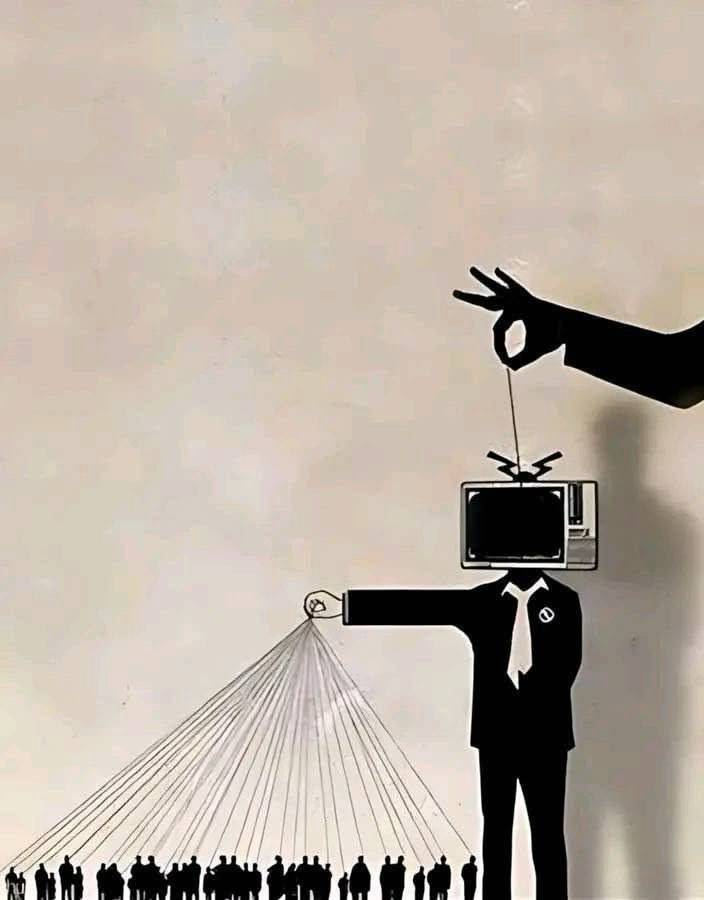
The image selected for this study represents the relationship between media, influence, and power. It shows a television-headed figure controlling a crowd like puppets, while a hand above appears to control the television-headed figure itself. The image therefore raises questions about who creates media messages, how these messages may influence audiences, and how audiences respond to the information they receive. However, people do not necessarily understand or respond to the same media message in the same way. This makes individual interpretation important when examining the relationship between media and political influence. Therefore, this study explores the following research question:
How do people understand, encounter, and respond to political messages and influence across different forms of media?
Methods
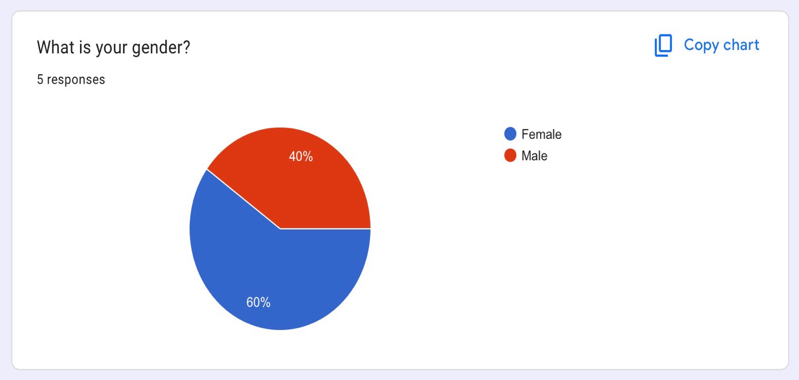
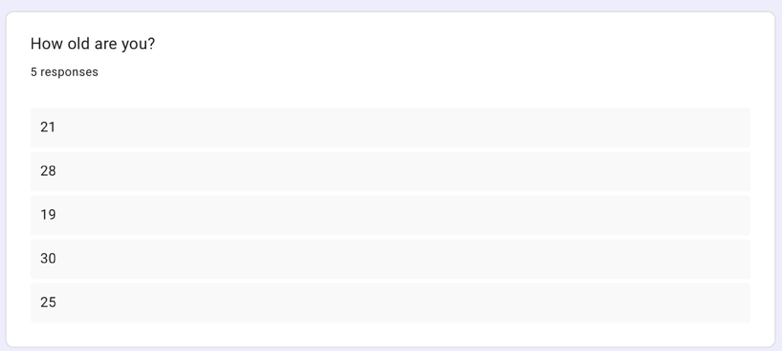
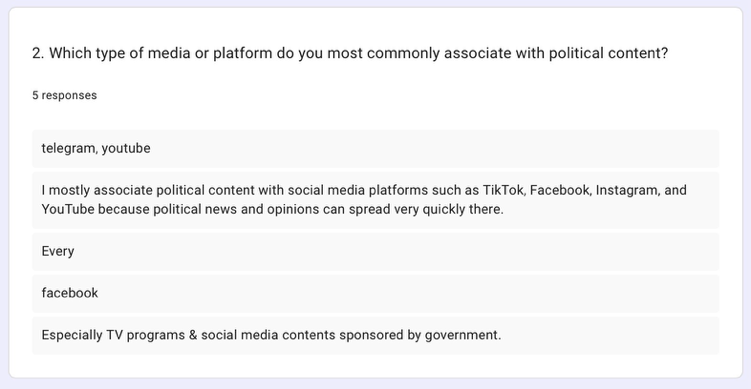
This study used qualitative interviews to explore how individuals interpret and respond to political messages and media influence. Five participants between the ages of 19 and 30 from Myanmar and Thailand participated in the study. Each participant was shown the same selected image and asked five open-ended questions. These questions explored their initial interpretation of the image, the media platforms they commonly associate with political content, whether entertainment can communicate political values or ideologies, whether political media has influenced their own views, and whether they had experienced believing information from media that they later discovered was inaccurate or misleading.
Open-ended questions were used to give participants the opportunity to describe their personal opinions and experiences in their own words instead of limiting their answers to predetermined choices. After all responses were collected, they were reviewed and compared to identify repeated ideas and similarities among participants. These recurring patterns were grouped through thematic analysis into two main themes: “How Media shapes people’s views on politics” and “Questioning what we see in Media”. These themes were then used to organize the interview findings presented in the Results section.
Results
The interview responses revealed two main themes concerning participants’ perceptions of political media: (1) How media shapes people’s views on politics and (2) Questioning what we see in media. The first theme highlights participants’ recognition of the influence media can have on political and social perceptions, while the second focuses on participants’ efforts to critically evaluate and verify the information they encounter.
Theme 1: How Media Shapes People’s Views on Politics
Four interviewees (1, 2, 4, and 5) discussed the role of media in shaping people’s political views and understanding of social issues. Their responses suggested that participants viewed media as more than a source of entertainment, recognizing its ability to influence how individuals perceive political and social realities.
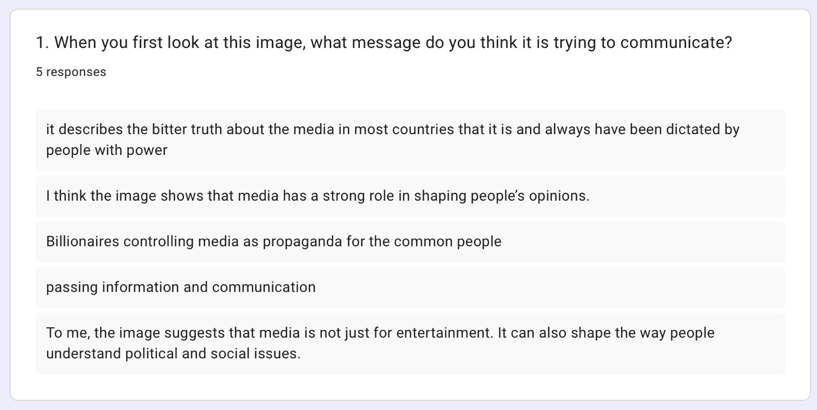
Interviewee 1 directly emphasized this influence, stating that “Media has a strong role in shaping people’s opinions.” Similarly, Interviewee 2 noted that “Media is not just for entertainment. It can also shape the way people understand political and social issues.” This indicates that participants recognized that media can contribute to how people interpret issues beyond explicitly political content.
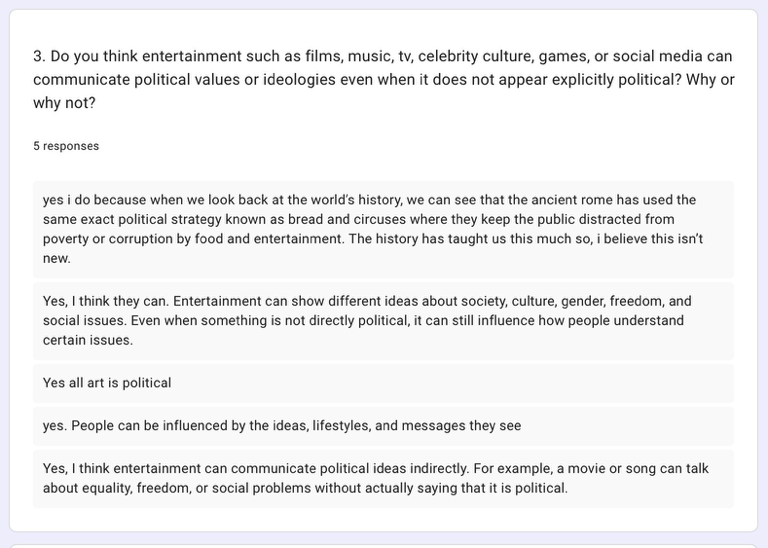
Interviewee 4 further suggested that media influence can occur through the “ideas, lifestyles and messages” presented to audiences. This broadens the understanding of political influence beyond direct political reporting, suggesting that the content and values presented through media may also affect people’s perceptions.
Interviewee 5 focused more specifically on the relationship between media and political power, describing media as “dictated by people with power.” This response reflects a concern about the influence of powerful actors over media and the potential implications this may have for the information audiences receive.
Overall, the responses under this theme demonstrate that four interviewees perceived media as having an important role in shaping opinions, understanding, and perceptions of political and social issues.
Theme 2: Questioning What We See in Media
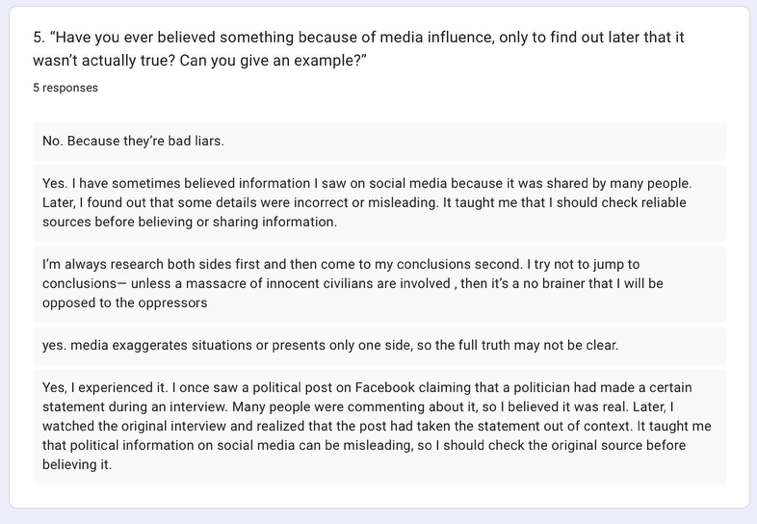
Four interviewees (1, 2, 3, and 4) emphasized the importance of critically evaluating information encountered through media. Rather than accepting political information immediately, participants described different approaches to questioning, researching, and verifying what they saw.
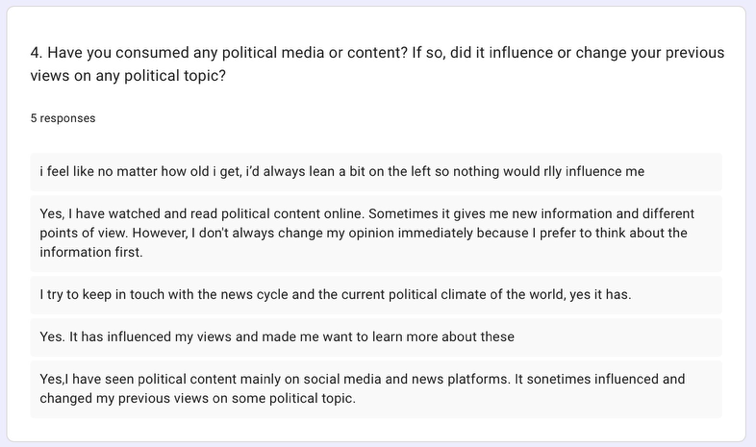
Interviewee 1 explained, “I don’t always change my opinion immediately because I prefer to think about the information first.” This suggests that the participant approaches political information with some degree of reflection before allowing it to affect their existing views.
Similarly, Interviewee 2 expressed concern about the reliability of political information on social media, stating that it “can be misleading” and that they should “check the original source before believing it.” This highlights source verification as one strategy participants use when encountering potentially unreliable information.
Interviewee 3 described a process of comparing perspectives, stating, “I always research both sides first and then come to my conclusion second. I try not to jump to conclusions.” This response demonstrates an emphasis on considering multiple perspectives before forming a judgment.
Interviewee 4 also questioned the completeness of media representations, observing that “media exaggerates situations or presents only one side, so full truth may not be clear.” This reflects concerns about selective or exaggerated presentation and the possibility that audiences may not receive a complete picture of an issue.
Overall, the responses indicate that participants were aware that political media may be incomplete, misleading, exaggerated, or influenced by particular perspectives. Four interviewees therefore described approaches such as reflection, checking original sources, researching multiple perspectives, and avoiding immediate conclusions when engaging with political media.
Discussion
The findings suggest that media can influence political understanding not only through direct political news but also through entertainment and everyday media consumption. The two themes, “How Media Shapes People’s Views on Politics” and “Questioning What We See in Media,” show two sides of media influence. Participants recognized that media can shape political and social perceptions, but they also described ways of questioning and checking the information they encounter. This connects directly to the research question of how people understand, encounter, and respond to political messages across different forms of media. The visual evidence supports this relationship between media, power, and audiences. The image shows a television-headed figure controlling a crowd, while another hand appears to control the television itself. This connects with Interviewee 5’s statement that media can be “dictated by people with power,” suggesting that political communication involves not only the audience receiving information but also the people and institutions that influence what information is presented.
Interviewee 5’s reference to “bread and circuses” provides an important historical comparison. The concept is associated with Ancient Rome, where food and public entertainment were connected to the relationship between political authorities and the population. Roman spectacles, including gladiatorial games, were not simply entertainment; they could also function as important public and political spaces. Sumi (2021) explains that spectators at Roman spectacles could collectively respond to political authorities and communicate their opinions. This means that entertainment should not automatically be understood as a tool that simply makes people passive. Instead, entertainment can create a relationship between authorities, audiences, and political power. The idea of bread and circuses can be connected to modern entertainment because people may spend significant amounts of attention on films, television, celebrity culture, games, and social media while political information exists alongside this content. Prior (2005) argues that increased media choice can create differences in political knowledge because people can choose between news and entertainment according to their preferences. This supports Interviewee 5’s point that entertainment can potentially distract audiences from political issues. However, it is important not to assume that entertainment always prevents political engagement.
Entertainment can also communicate political ideas without appearing to be political. Holbert (2005) identifies entertainment television as an important area of political communication research because entertainment programs can have sociopolitical effects. More recent experimental research also found that political messages presented through both news and fictional formats could influence political attitudes (Knobloch-Westerwick et al., 2021). This supports the first theme because political influence can occur through content that audiences may initially approach as entertainment rather than political information. At the same time, the second theme shows that participants were not completely passive audiences. Interviewees 1, 2, 3, and 4 described checking original sources, researching different perspectives, and avoiding immediate conclusions. This is important because media influence does not necessarily mean that everyone receives a message and responds to it in the same way. Bartsch and Schneider (2014) found that some forms of entertainment can actually stimulate political interest and information-seeking, showing that entertainment can encourage audiences to become more politically engaged rather than simply distracting them.
Overall, the visual evidence, interview responses, and existing research suggest that media influence is more complex than simple political control. Media can shape what people notice, how they understand political issues, and which ideas they encounter. Entertainment can also communicate political values or attract attention away from political information, connecting with Interviewee 5’s reference to “bread and circuses.” However, audiences can actively question, compare, and verify media messages. Therefore, in answer to the research question, people encounter political influence through both direct political communication and everyday entertainment, while their responses depend on how they interpret and critically evaluate the media they consume.
Conclusion
This study looked at how people understand and respond to political messages in different types of media. Five people from Myanmar and Thailand were interviewed. The results show that the media can influence people in two main ways.
First, many participants believed that the media affects how people think about political and social issues. This influence does not only come from news. It can also come from Entertainment, such as films or lifestyle content which carries certain ideas and values. Second, participants also showed that they do not simply accept everything they see in the media. Many of them said they check information, compare different sources, and think carefully before forming an opinion. This shows that audiences are not always passive. They can be active and critical when they receive political information.
The image used in the interviews, which showed a television controlling a crowd while being controlled by a hand, helped participants think about power and control in the media. One participant's comment about "bread and circuses" connected this idea to history, showing that entertainment and political power have been linked for a long time.
Overall, the findings suggest that the relationship between media and political understanding is complex. The media can shape people's ideas, but people can also question and evaluate what they see. This matches earlier research showing that entertainment can carry political meaning, and that audiences often respond to media in an active way. Because the sample size was small and limited to two countries, the results cannot be applied to everyone. Future studies could include more participants from different backgrounds and also look at newer media forms to better understand how political ideas spread through media today.
References
Bartsch, A., & Schneider, F. M. (2014). Entertainment and politics revisited How non-escapist forms of entertainment can stimulate political interest and information seeking. Journal of Communication, 64(3), 369–396. Oxford Academic article
Delli Carpini, M. X. (2014). The political effects of entertainment media. In K. Kenski & K. H. Jamieson (Eds.), The Oxford handbook of political communication. Oxford University Press. Oxford Academic chapter
Holbert, R. L. (2005). A typology for the study of entertainment television and politics. American Behavioral Scientist, 49(3), 436–453. https://doi.org/10.1177/0002764205279419
Knobloch-Westerwick, S., Robinson, M., Frazer, R., & Schutz, E. (2021). “Affective news” and attitudes: A multi-topic experiment of attitude impacts from political news and fiction. Journalism & Mass Communication Quarterly, 98(4), 1078–1103. https://doi.org/10.1177/1077699020932883
Prior, M. (2005). News vs. entertainment: How increasing media choice widens gaps in political knowledge and turnout. American Journal of Political Science, 49(3), 577–592. https://doi.org/10.1111/j.1540-5907.2005.00143.x
Sumi, G. S. (2021). Spectatorship, control, and collective groups. In P. Christesen & D. G. Kyle (Eds.), The Oxford handbook of sport and spectacle in the ancient world (pp. 603–614). Oxford University Press. https://doi.org/10.1093/oxfordhb/9780199592081.013.49
Appendix
Visual Evidence
Interview Questionnaires
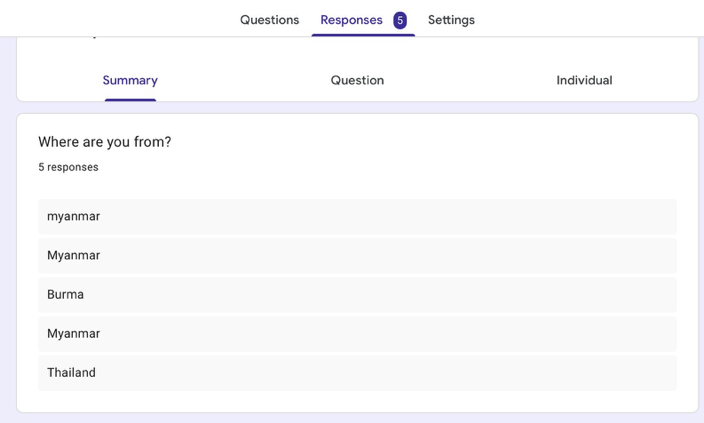
Where are you from?
How old are you?
What is your gender?
When you first look at this image, what message do you think it is trying to communicate?
Which type of media or platform do you most commonly associate with political content?
Do you think entertainment such as films, music, tv, celebrity culture, games, or social media can communicate political values or ideologies even when it does not appear explicitly political? Why or why not?
Have you consumed any political media or content? If so, did it influence or change your previous views on any political topic?
“Have you ever believed something because of media influence, only to find out later that it wasn’t actually true? Can you give an example?”
Publication record
- Article ID
- ODCS-V0-009
- Received
- 2026.09.17
- Language
- English
- Status
- Final published edition (original submission); editorial decision, not independent peer review
- License
- CC BY-NC 4.0
- Final editorial decision
- 2026.10.01
- Text-only archive DOI
- 10.5281/zenodo.23074771
Editorial decision: this is the final published version. Earlier screening notes and signed comments remain dated records; publication does not imply independent peer review.
Citation
Vitsitsono Seyie; Thon Phyo Nadi; Shon Lae Lae Khine; Seint Seint Htay. (2026). Beyond Entertainment: The Political Power of Media. Open Design & Card Studies. DOI: https://doi.org/10.5281/zenodo.23074771.
Text-only archival PDFThe DOI identifies the separate text-only archival edition. Images, concept posters and image-based supplementary sheets are omitted; textual captions and sources are retained. The CC BY-NC 4.0 license applies to original author text, not third-party material or participants' quoted responses.
Original DOCXEarlier editorial note
Published with the author(s)' agreement to full-text publication under CC BY-NC 4.0. The submitted English manuscript is retained, with paragraph, table and figure layout adapted for web reading. This is an open review edition; independent review and final acceptance are pending.